

by Jose Quinteros
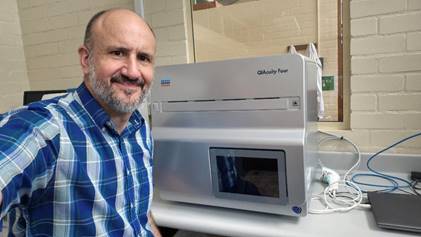
In January of 2026, the research teams based in Camden (Infectious Diseases Laboratory, Poultry Research Foundation and Plant Breeding Institute) acquired by Capital Expenditure (CAPEX) fund a Digital PCR machine from QIAGEN Australia (QIAcuity). This CAPEX application was led by Dr Jose Quinteros, Lecturer in Poultry Health at the School of Veterinary Sciences.
How does it work? The digital PCR (dPCR) system measures the amount of DNA or RNA in a sample with very high accuracy. Unlike traditional PCR methods (such as quantitative PCR or qPCR), digital PCR splits a reaction into thousands of tiny partitions, and each partition is checked to see whether the target genetic material is present (“positive”) or absent (“negative”). This approach turns molecular detection into a simple counting problem, making the technique highly precise. The dPCR platform performs this using nanoplate technology, which offers fast and reliable processing.
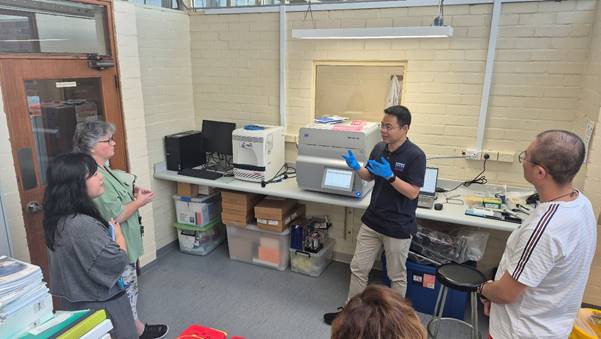
How can it quantify copies of the target? The key scientific idea behind digital PCR is the use of Poisson statistics. Molecules are randomly distributed across many small partitions, so some wells receive zero molecules, some receive one, and a few may receive more. After PCR amplification, the instrument counts how many partitions are positive. Using the fraction of positive versus negative partitions, software calculates the original number of molecules using the Poisson distribution, which describes the probability of random events occurring in fixed spaces. Because of this mathematics‑based counting, digital PCR provides absolute quantification. It tells you exactly how many copies of a gene or viral target were present in the original sample, expressed as copies per microliter.
This capability is extremely useful in gene expression studies, where measuring small differences in RNA levels can be important. Digital PCR can detect rare transcripts or subtle changes more reliably than older methods because it is less affected by reaction efficiency and does not need a standard curve. It is also powerful for measuring viral genome load, for example comparing viral quantities across samples or timepoints. Because the measurement is absolute, results can be compared directly between experiments or laboratories.
In contrast, traditional quantitative PCR (qPCR) estimates quantity indirectly. It measures fluorescence as DNA amplifies and then compares this to a standard curve built from known concentrations. The qPCR also typically requires reference genes for normalization—genes assumed to remain constant across samples (which is not always the case). By comparison, dPCR needs neither standard curves nor reference genes, because it counts target molecules directly.
Overall, the dPCR system offers a precise, user‑friendly approach to measuring nucleic acid amounts, improving accuracy in applications ranging from research to diagnostics.
If you are interested in this technology, do not hesitate to contact Dr Jose Quinteros, [email protected], and talk about how dPCR may adapt to your research and diagnostic’s needs.