

By Milan Kandel
Soybean meal (SBM) is the most used plant protein source in broiler diets because of its high protein content, balanced amino acid profile and its high digestibility. However, in Australia, soyabean is not grown in sufficient quantities and therefore heavily dependent on imports. This dependence increases feed costs and exposes the poultry industry to risk of supply chain disruptions caused by freight constraints, global market volatility, and geopolitical conflicts. So, there is increasing interest in identifying alternative protein sources that are locally available, cost-effective, and nutritionally suitable for broiler diets such as field pea, canola products etc.

PhD Candidate, University of Sydney
Here at Poultry Research Foundation within University of Sydney, researchers conducted a study to explore alternatives to soybean meal (SBM) in broiler diets. Specifically, they investigated whether SBM could be partially or completely replaced by a combination of field peas and canola products without compromising growth performance, nutrient digestibility and carcass traits in broiler chickens. This approach aims to support ongoing industry efforts to minimizing the use of imported and resource-intensive ingredients, such as soybean meal, thereby promoting the sustainability of chicken meat production.
This feeding trail involved 300 Ross 308 (mixed sex) broiler, randomly assigned to 60 pens, with each dietary treatment tested in 10 replicate cages of five birds each. The study followed a 3 × 2 full factorial design, testing three levels of SBM inclusions – standard, medium, and low/nil either with or without field pea inclusion. In total, six dietary treatments were fed over a 42-day post-hatch with four commercial phases: starter (0-10 days), grower (11-24 days), finisher (25-35 days), and withdrawal (36-42 days). Diets were formulated to meet Ross 308 nutrient requirements during each phase. This experiment involved the inclusion of field peas at increasing levels of 50, 80, 100, and 120 g/kg, replacing nearly 45%, 60%, 100% and 100% of SBM, in the respective feeding phases. This variation in SBM levels led to changes in NBAA inclusion and total dietary crude protein as well. Researchers assessed growth performance, nitrogen retention, and nutrient digestibility during this experiment.
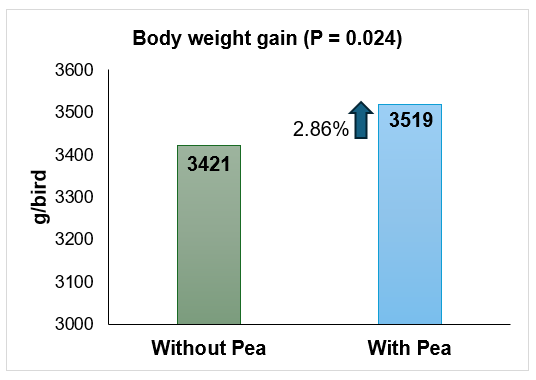
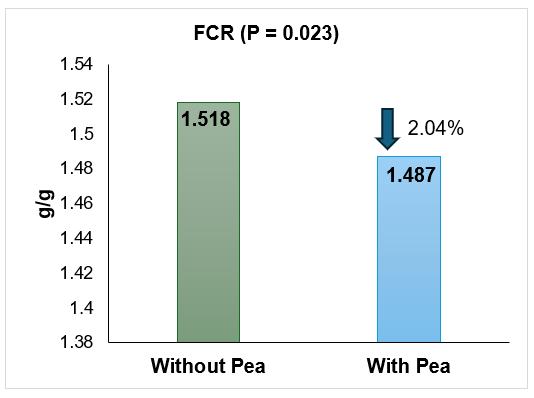
Key findings showed that field pea inclusions improved growth performance, with body weight gain increasing by up to 2.9% (3421 versus 3519 g/bird, P = 0.025) and FCR improving by 3.1 (1.518 versus 1.487, P = 0.024) points over the 42 days, regardless of SBM levels in the diets. Reducing SBM levels improved protein digestibility and nitrogen retention; however, starch digestibility was not affected. There were no significant effects on carcass yield and fat pad weights. Furthermore, diets with low SBM inclusion resulted in higher ileal digestibility of valine, glycine, and proline. These results also support the idea that a proper blend of protein-bound and non-bound amino acids is necessary for optimal broiler performance.
Figures: Main effect of pea inclusions for 0-42 days post-hatch
From an industry and sustainability perspective, this study is highly relevant. It supports the potential for reducing reliance on SBM, a costly and environmentally intensive protein source, by replacing it with locally available alternative protein sources such as field peas, canola products with NBAAs. For producers, nutritionists, and feed manufacturers, these practical implications are considerable. Field peas can be safely included at 5-12% of the diet, and SBM can be entirely removed during the later growth phases without compromising bird performance and pea-included dietary treatments reduced wheat and canola inclusions, which could be also factor for better growth performance. In addition, dietary pea inclusion reduced dietary starch: CP ratios in all phases. This lower dietary starch-to-protein ratio might be advantageous. Finally, this research offers a practical opportunity to reduce feed costs and nitrogen waste, aligning with environmental sustainability goals.
Future research opportunities include exploring the gut health benefits of legumes such as field peas, particularly their influence on microbial populations and short-chain fatty acid production and further investigating why field peas enhance growth performance despite no observable changes in starch digestibility. These findings were published in the Animal Nutrition Journal and can be accessed online here: Kandel, M., Toghyani, M., Macelline, S. P., Selle, P. H., Zadoks, R. N., & Liu, S. Y. (2025). The impact of soybean meal and field peas inclusion on growth performance, carcass traits and nutrient digestibilities in broiler chickens offered wheat-based diets. Animal Nutrition. https://doi.org/10.1016/j.aninu.2025.03.011